Showing posts with label Your Junk my Happy Zone. Show all posts

Quarter Post Team Metrics

Your Junk my Happy Zone
by Brandon Corbett

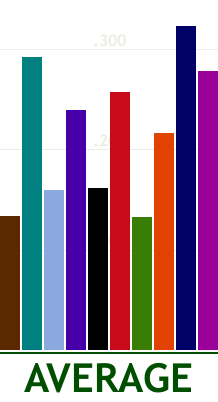
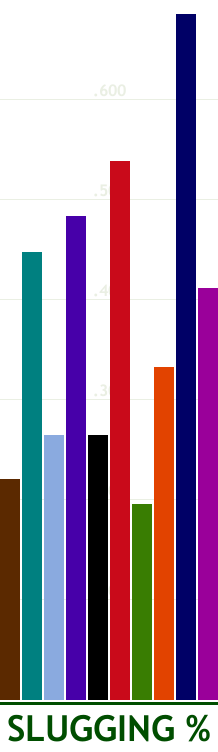
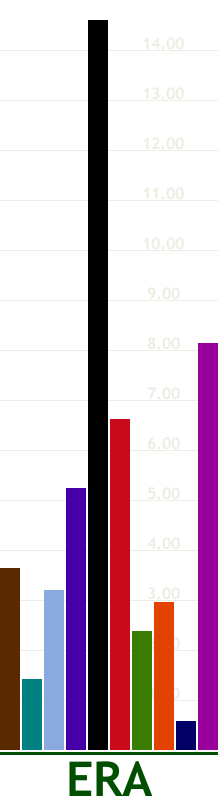
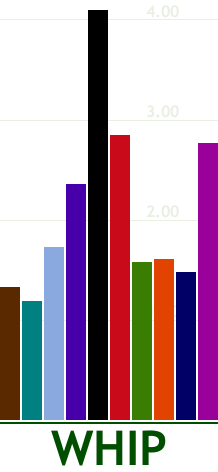
 BW  EL  FS  HB  IS  KF  ON  WW  WA  WO


There's an oddity to note with AVG — 3 .500+ teams (Onanism, Belgian, and Squirrels) sit in the bottom 3 spots, behind even the league's 3 sub-.500 squads (Isles, Balls, and Friday). Proponents of offense's role in success will be pleased to see the division leaders, El Diablos and Aces, in spots 1 and 2.

The distribution of teams across SLG% remains largely the same as AVG. The notable exception being Friday and the Balls jumping over El Diablos and Wolfpack into the second and third spots. So much for offense being an indicator of success.

As you might expect, ERA pairs more closely with the standings. 6 of the top 7 teams lead the pack with numbers under 4.00. The anomaly is Wolfpack: .500 and second place in Garcia, but 9th with an 8.14 ERA. The division leaders once again find themselves in spots 1 and 2.

Aided by 3 perfect games Belgian gets their best showing, edged out by only El Diablos. WHIP produces a tight pack, too, as 5 teams sit within 0.4 of one another. The Balls at seventh is once again cause for head-scratching, given the 2-6 start.

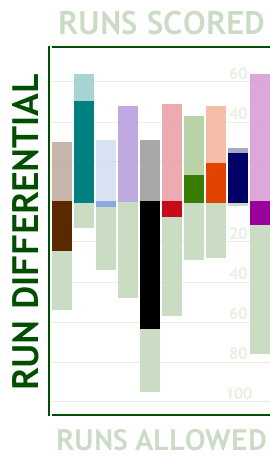
Run differential seems like a smart bet to identify team success — or lack thereof. But nope. Only 2 teams (Wolfpack at 7 and Isles at 10) occupy the same positions. A team at .500 yet 24 runs under; a team 4 games under .500, but even on run differential... One thing can be said with a degree of certainty, though: Wolfpack games are not pitchers' duels.

This... is my Boomstick! Comparing Offensive Stats from 2012 to 2013

Your Junk my Happy Zone
by Brandon Corbett

Feliz Dia de Los Muertos! Let us talk about things that have come and gone. A lot was made of the bat switch this past season, and a lot of fun was had with the bat switch this past season. But what exactly did the bat switch mean when all was said and done?

The trick to comparing 2012 and 2013 stats from WSEM is that you cannot take the numbers at face value. Since, the two seasons featured a different number of teams playing, and thus a different number of games played, you must first account for that by dividing the "counting" stat categories by the number of teams involved: 8 for 2013, 10 for 2012. After doing that you will see that the number of hits per team saw a modest increase of 15.6% this season. That is just about exactly what we were looking for with the switch. It led to a league-wide batting average of .263, which falls just north of the MLB average of .253. For comparison: the WSEM average in 2012 was .226.

Stat % change from 2012-2013
H/team 115.6
2B/team 142.0
3B/team 62.5
HR/team 171.4
TB/team 132.5
BB/team 178.0
R/team 196.7
AVG 116.4
SLG 133.5
OBP 128.7
Stat WSEM '12 WSEM '13 MLB '13
AVG .226 .263 .253
SLG .360 .481 .396
OBP .355 .457 .318
R/G 2.43 4.78 4.17
PA/R 8.61 4.92 9.13
The power numbers are where things really took off. The .037 (16.4%) increase in league batting average led to more than triple that for slugging percentage, with a league-wide jump of .121 in that stat: an increase of 33.5%. Bolstering that inflation were the number of doubles per team increasing by 42%, while the number of home runs per team saw a staggering 71.4% increase. Obviously, the bigger barreled bats account for part of the boom, but can we really find them solely responsible for the power surge? After all: "band boxes" and "tail winds" were things evidently. The fact that triples per team decreased by 37.5% this past season seems to back up the shared role that smaller fields other factors also played in the slugging increase. Now for a related, but irrelevant, fun fact: there were only 7 triples hit in the 2013 season, and each came from a different player.

One more place the bat switch was hugely successful, and my favorite stat boom to see from 2012 to 2013, is how runs per team nearly doubled this season! That 96.7% increase moved home plate from the desert littered with 15+ inning 1-0 affairs to much more fertile tracks of land. Another way to look at the run production boost is how many plate appearances came between there were per run scored. In 2012 this number was 8.61, and it dropped sharply to just 57.1% of that in 2013: 4.92. Bringing a run around to score every fifth batter instead of every eighth or ninth certainly makes for much more exciting action for the 75% of the league who are not pitchers. Plus, when you look at the minimum number of plate appearances in a game (15 for WSEM, 27 for MLB), having our PA/R be a little over half the MLB makes it much more analogous.

One thing here that does not make the game more exciting, unless you are the Mayor or Billy Beane, is the big 78% jump in walks per team. Much like the HR/team numbers and overall slugging percentage, though, the big change in this one stat only corresponds to a league-wide on-base percentage increase of 28.7%, slightly less than double the increase in league batting average. In the spirit of full disclosure, I find myself quite responsible for the large increase in walks: in 2013 I had 46 walks, which perfectly matched my number of career walks from the previous two seasons combined.

The inflated walk total seems to be something that is already remedying itself. Pushing the mound back three feet was something we knew would make pitchers adjust, and those adjustments seemed to be made as the season went on: i.e. pitchers found the zone with more practice from 48'. Figuring I needed some facts to back that statement up for this article, I ran the numbers for five random pitchers. I took their walk totals over their first five games in 2013, then compared that to the rest of their season. All but one of those five pitchers saw a decrease in walks per inning as the season went on. These four all saw double-digit percentage decreases in their walks: 13%, 17%, 25%, and a Jim Price "wow!" worthy 67%. In addition, two of them were giving up less than one walk per inning over the second half of their season. The takeaway here? Pitchers are only continuing to get better from 48', and walks will settle down.

That is essentially what we expect heading forward: the offense had an up year last year with the changes, now - with no sweeping rule changes - pitching will start to counter. Managing the quality of competition in a Wiffleball league is a balancing act. Pitching will always be the centerpiece of Wiffleball; pitching prowess is the reason the ball exists, after all. But with the majority of players in the league never toeing the rubber, it is nice to see the pitchers take a slap across the face once in awhile.

Wild Cards

Your Junk my Happy Zone
by Brandon Corbett

With six weeks left in the season four teams have a realistic shot at the two wild card slots. All four - Ducks, Balls, Friday, and Warriors - have recently signed new roster acquisitions that strengthen their lineups and/or rotations for a playoff push. Current leaders in the Wild Card race, Westside Warriors, have reactivated Sam Hatt who had a lower body injury at the start of the season. Both on the mound and at the plate, Sam's presence will be a "huge boost for the team!" as praised by Alex Shore. Holy Balls, who currently hold the second Wild Card slot, have seen their offense surge after the signings of David Castle and rookie Andrew Piasecki. Castle is hitting .600 with three doubles, a
Wild Card
TEAM W L E#
Warriors 11 5
Holy Balls 10 6
King Friday 6 8 11
Ducks 6 8 11
Islanders 4 16 3
Belgian Wiffles 4 20 E
triple, and eleven runs scored since joining the Balls; in six games, Piasecki has three home runs, eleven RBI, is hitting .381 and slugging .810.

Not to be outgunned, the trailing teams have also bulked up. The Ducks signed a rookie of their own, hard-throwing lefty Phillip Morris (not to be confused with big tobacco, but who wants to bet we start calling him that?). In his first appearance he recorded every out by strike out, but was a little wild: walking 13, including two runs pushed across. Michael Sessions of the Islanders added, "Morris' debut was exceptional as he homered on his first at bat." Rumors of Morris being "the left-handed Pearson" seem like they could be true; good news for the Ducks if so. King Friday made the biggest splash of any midseason signings with the six-player trade between themselves and Belgian. Mark Brannan, Greg Brannan, and Jason Hollister add a second strong arm to the King's rotation and some much need power in their lineup. In their first series with the team, Greg hit .500 with four home runs, Hollister also got in on the home runs with one of his own, and Mark - while not getting out of the park - hit a cool .500 with seven runs scored.

The biggest moves seem to have already been made, but with the trade deadline half a week away (June 25th) there is still a chance one of these teams could make another move for the stretch run. With that in mind let us take a look at the obstacles and advantages presented to these four teams over the final five weeks of the season.
Strength of Schedule = (∑(# of games remaining vs. Team * winning % of Team) / # of games remaining) * 10   


Current Position Games Remaining Strength of Schedule
1st Wild Card 12 6.24
Home:  DU,  HB,  WA Remaining Schedule Road:  DU,  KF,  WA
Anyway you look at it, four games to play against the Wicked Aces is rough. The remainder of Westside's games all being against teams in the playoff hunt can go either way, depending on your level of optimism. On one hand it makes the road that much tougher, and losses to trailing teams give them twice the boost. However, wins coming in those series will beat those teams back with twice the impact. This is a tough road. Realistically, going 5-7 over this stretch of the schedule would be impressive, and that could be enough to secure a playoff berth with their current 3 game lead.

Tiebreakers
H2H: 2-0 vs. against KF, cannot give up the tiebreaker / 1 more win earns it;  0-2 vs. HB, cannot get the tiebreaker;  yet to play DU, up for grabs
Diff: Sitting at +8:  5 ahead of DU and KF (+3),  32 behind HB (+40)


Current Position Games Remaining Strength of Schedule
2nd Wild Card 12 4.71
Home:  DU Remaining Schedule Road:  BW,  IS,  KF,  WW,  WA
Whereas Westside has 12 games remaining against playoff contenders, the Balls have just 8: 2 against Whiteford, and 2 against each team chasing the Wild Card. There are still some tough series in there, but what makes the Balls schedule a much safer path to the playoffs is that they close out the season with four games the against Islanders and a deflated Belgian team. Getting 7 wins over their final 12 games is not asking much. Another thing in the Balls' favor is their opportunistic standing with the tiebreakers. There is only one of the three head-to-head variety they can potentially lose; following that, they have a commanding lead in run differential over the other teams in the running.

Tiebreakers
H2H: 2-0 vs. KF and WW, cannot concede either / 1 more win earns either tiebreaker;  1-1 vs. DU, tiebreaker up for grabs
Diff: Sitting at +40:  32 ahead of DU and KF (+3),  32 ahead of WW (+8)


Current Position Games Remaining Strength of Schedule
3 Games Back 14 6.00
Home:  DU,  HB,  IS,  WW,  WA Remaining Schedule Road:  DU,  WA
Friday's remaining schedule is essentially a mirror of Westside's, including two dangerous series against the Wicked Aces. The one difference is the two extra games left to play, which come at home against the Islanders. Holding no tiebreakers at the moment, Friday needs to play 3 games better than Balls and Warriors, while taking both games remaining against both teams to avoid conceding to them the head-to-head tie-breaker. In all likelihood, they need to get 9 or 10 wins in their final 14 games to clinch a playoff berth. It will not be easy, but the restocked Friday roster has the advantage desperation provides on their side.

Tiebreakers
H2H: 0-2 vs. HB and WW, cannot get either tiebreaker;  yet to play DU, up for grabs
Diff: Sitting at +3:  tied with DU (+3),  5 behind WW (+8),  37 behind HB (+40)


Current Position Games Remaining Strength of Schedule
3 Games Back 14 6.37
Home:  EL,  KF,  WW Remaining Schedule Road:  HB,  EL,  KF,  WW
The Ducks are the only team in the Wild Card hunt who are done with the Wicked Aces. However, they are also the only team with games remaining against El Diablos. Call it a push. Like Friday they need to play 3 games above the leaders to have a shot at making the playoffs. But like Westside they face the hard track of having to accomplish that task against a schedule entirely of teams in a playoff push of their own. One possible reprieve for the Ducks is that the head-to-head tiebreaker between them and each potential Wild Card team is still wide open; this yields a slight edge over King Friday while coming from the trailing position. However, the fact their additional games come against Westside (instead of the Islanders, as in Friday's case) makes their schedule that much more difficult to accumulate those wins.

Tiebreakers
H2H: 1-1 vs. HB, tiebreaker is up for grabs;  yet to play KF or WW, both are up for grabs
Diff: Sitting at +3:  tied with KF (+3),  5 behind WW (+8),  37 behind HB (+40)

The Offensive Resurrection

Your Junk my Happy Zone
by Brandon Corbett

With yesterday being Easter Sunday and the season finale of The Walking Dead you would think those would have a duopoly on resurrections. However, you would be wrong. The biggest news in resurrections this weekend is the bats in WSEM!

One of the greatest things about Wiffle is the challenge it presents to the hitter and the creativity it lends to pitchers. That said, those hitters and how much they enjoy playing is every bit as integral to the game. Pitchers dominated in 2012, so we made a few rule adjustments to improve the experience from the hitters' perspective: correcting the pitching distance (which was always supposed to be 45' from the plate) and bringing in the Easton Pro Stix and Louisville C271 bats.

2012 Season RPG
All teams: 2.7
Winning Teams: 4.6
Losing Teams: 0.7
2013 Sat. #1 RPG
All teams: 6.1
Winning Teams: 9.2
Losing Teams: 3.0
The average runs scored by teams at the first Satellite Tournament on Saturday was 6.1 per game. Breaking that down further we get 9.2 runs scored per game by winning teams and 3 by losing teams. During the rough 2012 season teams averaged just 2.7 runs per game; winning teams averaged 4.6 and losing teams averaged a bone chilling 0.7 runs per game.

In slightly less analytical terms for those just observing the games: of the eleven games played on Saturday there were only two in which a team was held scoreless, while ten games saw a team score seven runs or more. Furthermore, five games saw both teams score three runs or more. While a niche group exists that loves pitchers' duels, for most people more scoring chances, more runs, and more action mean better excitement.

Sure, this was one day in March and not a full season. Sure, this was the first opportunity for many teams to play together and try things out. Sure, batters may be a bit ahead of pitchers at this early point. But if we look at the small sample of numbers from 2012 "spring training" we see that they are very pitcher friendly: 0.7 runs per game per team, 2 runs per game for the winning teams, and 0 scored by losing teams. Those pretty much held up to tell the story of the 2012 season.

Popular opinion is that the bats are going to see a resurgence this year, and the early numbers support that assertion. Hopefully so, because when the people are having fun this game gets better and better!

Bold Ass Predictions

Your Junk my Happy Zone
by Brandon Corbett

For those unfamiliar, a bold ass prediction reaches well beyond expectations. It is absolutely not a safe bet; saying it may call into question your credibility and sanity. When it comes true, though, having said it earns you the respect of a savant. Feel free to share any of your bold ass predictions in the comments, and sign your name so we can praise your foresight in August. Here are five of my bold ass predictions for 2013.


Nick Coffee will have double-digit extra base hits.
He had zero in 2012, but his bat began livening up late and in offseason games. Nick's routinely knocking the ball over outfielders heads, and even blasting a couple monster home runs. Only 9 players in 2012 had double-digit extra base hits (6 of them with less than 15), so this is a greater feat than it at first may seem. I think he'll do it the hard way, too, by keeping it in the park for most of them: 7 doubles, 4 home runs. All this attention paid to his offense, though, will once again see Nick snubbed for a Diamond Digit.


The Westside Warriors will win the 2013 Commissioner's Cup.
There are many questions about what their final roster may be, but I'm buying the hype that Alex Shore is selling. With the list of names he's working with you can count on the Warriors running out a talented squad every game day, regardless of whether or not some pieces change from week to week. Also, even if only featured in a limited role, the addition of Sam Hatt sends Westside's stock skyrocketing. He and Shore will be a dangerous 1-2 lefty punch in the lineup, and his guidance can also calm Maclin Malloy's "Wild Thing" tendencies on the mound: making for a lights-out rotation.


Chandler Phillips will lead the league in Ks.
Chandler was fourth in 2012 with 131, just 10 shy of the league lead. He only toed the rubber in 7 games, however, for a total of 52.1 innings. While true that all the 2012 K leaders pitched between 50 and 55 innings, I expect Chandler's innings to increase to around 65 this season as he gets more regular starts. His KPI of 2.5 will see him cutting down 162 batters on the season, running away with the "K crown" as the pitchers ahead of him in 2012 are not likely to see their innings increase


The Wicked Aces will throw 5 perfect games on the season.
Justin Hughes, Evan Bischoff, and Austin Bischoff all threw one in 2012. New signing, Evan Bortmas, threw two. The bats may be bigger and the mound further, but these pitchers will just be better. Evan (Bischoff) will reprise his against King Friday; Bortmas will avenge his only loss from last season by sitting the Squirrels down; Hughes will get one against the Islanders; and Austin will come up with two in huge games: the first against El Diablos, and then a nine inning thriller against the Ducks in the playoffs as the exclamation.


Ryan Alexia will lead the league in stolen bases.
Alexia had a .377 OBP last season, which was over two-times his AVG. His second year in the league will bring an increase in number of hits, and that good eye of his will inflate his OBP into the high .400s. Expect David Buhr to employ steals intelligently as a new facet of the game. We will see Ryan turning singles or walks into doubles and scoring opportunities at will for the Belgian offense: successful in seven out of nine attempts, three of which set up a game-winning run.

What Makes the Best Pitcher?

Your Junk my Happy Zone
by Brandon Corbett

There are a lot of good stats you can go with to tell you who the best pitcher is. Most commonly these are ERA, WHIP, and even strike outs, now that innings are controlled by the rotation in WSEM. If you want to crunch numbers a bit more to see exactly what a pitcher is doing, stats like strike out-to-walk ratio (K/BB) and strike outs per inning (KPI) may get tossed into the mix. K/BB is beautiful, because it speaks to a pitcher's command. It does not say much about his stuff, though. KPI, on the other hand, tells of dominant stuff. However, when used alone it is flawed in that a pitcher could strike out three batters an inning, which looks phenomenal, but then walk six and give up four runs at the same time - which is the opposite of outstanding.

It is also true that strike outs are not the only arrow in a pitcher's quiver. Many pitchers are good at getting batters to roll over on a pitch for harmless ground outs, or catching batters out front for lazy pop flies. These are not skills to be ignored, but when you talk about "the great pitchers" - the ones you want to run out in the big game - you know you want the guy who will take the game into his hand and mow down batter after batter. The pitcher who puts the ball in play for his defense may get the job done, but he gives the offense a chance with that; the pitcher who strikes out just about everyone does not give the offense any chance.

This is why KPI, despite its blind spot, is a valid stat: intimidation and dominance. There is also a way to erase that blind spot. WHIP (walks and hits per inning pitched) is the exact counterpoint to KPI: balls out of the zone and balls put in play, unable to be fielded. Therefore, using the simple formula KPI - WHIP does not punish a ground ball or pop fly pitcher (much), while it does bolster the impact of the strike out. Basically, this boils down to: number of unhittable or deceptive balls vs. poorly thrown or well hit balls. It is a way to simultaneously measure "filthiness of stuff" and command.

Zero (0) is even: KPI = WHIP. A "minus" (negative number) is more walks and hits than strike outs per inning. A "plus" (positive number) is more strike outs per inning than walks and hits. Additionally, a KPI - WHIP over 1.00 is considered a "super-plus"; there are seven WSEM pitchers who fall into this "super" category. Let us compare the top ten pitchers of 2012 by KPI - WHIP to Coffee Time's traditionally ranked 2012 top ten pitchers and see how things line up.

Traditional Measure
1. A. Bischoff
2. Hatt
3. Bortmas
4. E. Bischoff
5. Constanti
6. Skinner
7. Cosby
8. Pearson
9. Corbett
10. Phillips
KPI - WHIP
1. A. Bischoff +2.07
2. Skinner +1.84
3. Bortmas +1.78
4. Hatt +1.56
5. E. Bischoff +1.51
6. Phillips +1.28
7. Pearson +1.04
8. Cosby +0.72
9. Hughes +0.70
10. Shore +0.69
Overall, the lists are similar. Eight of ten pitchers show up on both. The most interesting part is who moves where. Craig Skinner jumps from slot 6 on the traditional list to number 2 under KPI - WHIP. Another Belgian-now-Diablo, Chandler Phillips, is also a big mover from 10 on the traditional scale to 6 under KPI - WHIP. Might having played for a "small market team" have effected their four-slot differences? Just asking... Big shifts in the other direction include Sam Hatt, going from 2 on the traditional list to 4 in KPI - WHIP, and Mike Constanti completely disappearing from the KPI - WHIP list 1, while in the fifth slot on the traditional scale.

Many do stay close to home, though. Number one, in every sense, Austin Bischoff holds the first spot on both lists. Evan Bortmas, also, occupies the third slot for both. Dennis Pearson and Adam Cosby flip slots 7 and 8, while Evan Bischoff comes in just one spot shy on KPI - WHIP from his traditional scale rank of number 4.

There is also some vindication in a player like Justin Hughes making his way onto the KPI - WHIP list. Hughes had a great 2012 season, but was overshadowed by his teammates for awards, All-Star votes, talk, and even top ten lists. When it comes down to numbers alone, he finally gets some recognition at number 9.

ERA is an important number to look at, no doubt. It is not going anywhere, and like AVG for hitters it will always be a "go to" stat. It does not tell the entire story, however, and that is why new categories keep popping up to shortcut determining the best. KPI - WHIP is not a "be all, end all" by any means. It does, however, take an intriguing stat in WHIP and add the "dominant stuff" factor into it. Who is the best pitcher? Will stats will ever really tell us that? Or will it all come down to the moment and who rises to the occasion to provide that answer? We will - and should - always try to determine that beforehand, and pinning dominance alongside command is as good a bet as any in determining who is the best of the best.

1 He is at number 11 with a +0.47

Stealing the Show

Your Junk my Happy Zone
by Brandon Corbett

Rules re: Steals in the 2013 Rulebook
-   Teams have 2 steal attempts per game.
-   While the pitcher is in their wind-up, a batter attempts a steal by shouting "STEAL" and leaving the base.
-   The pitcher must then throw the ball home; they may not step off the mound.
    -   If the ball misses the zone, the runner is SAFE.
    -   If the ball hits the zone, the runner is OUT.
    -   If the batter fouls off the pitch, an attempt will not be counted as used; the runner will return to the base.
    -   If the batter puts the ball in play, it is live and the attempt will be counted as used.
-   No double or triple steals.
    -   Only 1 runner with an open base in front of them may attempt at a time.
    -   If multiple runners attempt:
         -   The trailing runner(s) will be called out for leaving their base early.
         -   The lead runner's attempt will play out as normal.

WSEM players were given the chance to discuss their opinions on possible changes for 2013. Only one comment was made in response to steals, which was unfortunately anonymous, and could not be allowed through. The gist of that comment: Steals are fun and quirky, but they are based on luck and take away from the pitcher versus hitter dynamic.

Yes, shifting dynamics are a result of introducing a new facet of any game. However, having two steals per game is not going to render the pitcher versus hitter match-up obsolete. Steals introduce a new strategy into WSEM games, and that adds another level to an at-bat. All the presence of a steal does is ask the pitcher to be on the board. It doesn't tell him he can't throw a ball in the dirt to get a batter to chase; it tells him to be careful and aware when he throws it. It also increases a hitter's responsibility for runners on base. It is no longer just about bringing them around, his responsibilities now include making sure runners stay on base by fouling off close pitches. In fact, the whole team network will have to work together more in deciding the strategy for a game, and communicating to stay on the same page.

Let's look at a few situations where steals come into play.

1)  Late in a game, runner on second, no outs, a ringer coming up to the plate, hitting team has one steal. In the past, there would be no chance this big bat would see a single pitch to hit with first base base open. Now, the steal makes a pitcher stay on (or at least around) the board to keep the runner at second and from scoring on a sac fly.

2)  How often have we seen pitchers walk the bases loaded, and get out of it with three strike outs? With steals, that pitcher now has to dial it in sooner or find himself in a bit of trouble.

3)  Remember those extra-inning marathon games with a 1-0 or 2-1 score, where runners rarely get past second, that show up a handful of times a season? Intelligently using steals can help manufacture runs to decide those quicker.

4)  Go back to scenario 1, but this time the team has both of their steals. Now, that pitcher really needs to step up for his team and be on target. "Game 7, legend-in-the-making" kind of stuff.


Bottom line, steals take nothing away from the game or harm it in anyway. They demand pitchers be better. They beg runners to be more involved in the play and what is going on. They urge teams to think strategically about game situations. They should cut down on the ridiculously long games, which is addition by subtraction. They will insert some excitement into scenarios that used to be dull. But what about Anonymous' claim that steals also add luck to the game; is their truth in that?

In this system, the process of stealing a base involves about the same amount of luck as hitting a 75-80 mph pitch. You scout the pitcher, figure out his tendencies: Does he go for the board on the first pitch? If he is ahead in the count, will he try to make the batter chase? Are there any tells in his wind-up or delivery? Then, you use that information to guess what and where the next pitch will be, and decide whether to run or hold. This is the same technique you use at the plate against fireballers (assuming you don't just use the *flail like a madman!!!* technique). Guess the pitch and location right, you look like a hero; guess wrong and you look like a fool.

And that is what playing Wiffle is about: crossing back and forth over a fine line between ridiculous and awesome until it is completely wiped away. 60:30:10. Sixty percent of WSEM is the shenanigans and fun that happens at the field. Thirty percent is what spills over into the exaggerated media coverage. Only ten percent of WSEM is the result or competition on the field. Steals not only add a new layer of strategy to the game being played, but the boisterous cheers and deflating sighs they get in reaction play perfectly into the over-the-top atmosphere around the game, as well. That is the most important thing for this league.

Ducks are Covered

Your Junk my Happy Zone
by Brandon Corbett

The Ducks dropped the Thunder from their name and early forecasts saw them limping into the 2013 season. The reason for the dismal outlook was the departure of Chris Lewis and, founding member, Nick Braden to play for the Holy Balls. The move left powerhouse arm Dennis Pearson and big bats Dylan Braden and Josh Nagorski as the only ducks on the pond. Yes, the three totalled 28 HR in 2012, knocked in 68 runs and hit .287, collectively; an impressive three-hit combo to be sure. However, three men does not a Wiffleball team make; just ask the Belgian Wiffles in 2011 or the Manchester Punchouts in the 2012 Championship Series. Who would fill the needed slots on a Ducks roster expecting nothing short of a return to a second championship?

Well, it did not take long to see the big changes brought in - changes that center on one key facet of the game. Freed of the "thunder," the Ducks adopted a new look: a swerving Wiffle pitch with the ball and its trail forming a Ducks head and beak. That designing around the pitch has been the basis of the team's offseason strategy, as well. The Ducks first free agent signing was Mike Constanti. In 2012 with the Squirrels Constanti had a 0.56 ERA, 1.29 WHIP, and 79 K to 21 BB in 45 IP. Those numbers earned him the start for Garcia in the All-Star game; he now joins the other Garcia All-Star pitcher, Pearson, in the Ducks rotation. They were not done yet, though. David Castle, formerly with Belgian, was then signed as a third dangerous arm in their arsenal. Castle's season numbers were up and down, however, he turned it on when the games mattered in the playoffs: dialing up his speed and locking in his accuracy.


See Constanti deal in the first minute of this
video, then Castle starting at four minutes in.
These signings seem to be a measured response to being swept out of the playoff semi-finals by the Wicked Aces. Being able to run capably dominant starters out game after game, no matter the situation, is what the Aces were able to do on their march to the title, and now - on paper, at least - the Ducks have matched that ability and paired it with an always potent offense, which also looks to be bolstered by having Castle (.284, 19 RBI) in the mix. With eight of the nine current teams involved in the offseason movement of veteran players WSEM is going to look very different in 2013, but the Ducks have once again positioned themselves as one of the preseason favorites atop the league.

Taste the Rainbow

Your Junk my Happy Zone
by Brandon Corbett

Belgian Wiffles
RGB: 81, 61, 0
HEX: 513d00
RGB: 252, 248, 0
HEX: fcf800
Belle Islanders (*proposed)
RGB: 254, 161, 0
HEX: fea100
RGB: 0, 151, 254
HEX: 0097fe
Campus Commandos
RGB: 25, 68, 0
HEX: 194400
RGB: 171, 177, 53
HEX: abb135
Flying Squirrels
RGB: 138, 170, 223
HEX: 8aaadf
RGB: 62, 31, 15
HEX: 3e1e0f
Holy Balls
RGB: 71, 0, 169
HEX: 4700a9
RGB: 0, 0, 0
HEX: 000000
RGB: 225, 255, 0
HEX: e1ff00
King Friday
RGB: 201, 10, 26
HEX: c90a1a
RGB: 0, 63, 159
HEX: 003f9f
Thunder Ducks
RGB: 207, 181, 59
HEX: cfb53b
RGB: 32, 32, 32
HEX: 202020
RGB: 174, 179, 180
HEX: aeb3b4
Westside Warriors
RGB: 0, 0, 0
HEX: 000000
RGB: 226, 67, 0
HEX: e24300
Whiteford Wicked Aces
RGB: 0, 0, 102
HEX: 000066
RGB: 255, 255, 0
HEX: ffff00
When we first launched the website in 2011, Señor Café exalted his favorite part of the site as the teams page, seeing the wide array of colors next to one another. Not only does it liven up the look on the site, but a unique color scheme is one of the easiest ways to immediately stand out from the rest of the pack, too. Three teams have fallen to the ranks of "historic" after a year and half, with another four joining them after completion of season two, while we added four teams before 2012 and our looking at three new franchises for 2013. One thing that has remained the same, though: a splendid rainbow.

While not technically a color of the rainbow, brown is represented well and so very welcomed in WSEM. The Belgian Wiffles pair a lighter shade of the tone with a bright yellow, perfectly imitating the buttery goodness of their namesake and hearkening back to when the Padres had a respectable identity. The Flying Squirrels use a darker chocolate hue with a cooler sky blue, taking the color in a totally different direction with their look. The Squirrels will see many changes in 2013, including roster and logo changes, but their now iconic colors will remain part of their identity.

Despite what the table at right shows, red has been the most used color in WSEM's two years. Git r' Done was the sole team to utilize it in 2011 before changing to the gold and charcoal of the Thunder Ducks, when King Friday, the Donkeys, and the Manchester Punchouts donned it in 2012. Impressively, none of the teams ever shared the same shade. GR'D used a straight, bright red; King Friday kept the brightness, but muted the tone slightly, and paired it with royal blue for a very Pistons-like look; the Donkeys darkened up the GR'D tone a couple steps, and the Punchouts took the closest stab at crimson-esque color, fully invested in hexadecimal numbers. The Punchouts also used a dark, midnight blue along with an almost aqua to make for one of the best palettes in league history. Despite such a rich history, red - specifically maroon/burgundy - is one of the most standout colors out their for a new franchise in 2013.

In addition to Friday's use of royal blue, three other teams have touched the color. The Ass Kickers (2011) and Whiteford Wicked Aces use the same shade of navy blue. Both teams also use yellow as a secondary color; the Aces use a bright yellow, while the Ass Kickers used a more athletic gold hue in their tenure. The Mattseals also wore a royal (perhaps Dodger?) blue as their jerseys in 2012, although their primary color was a kelly green shade.

Aside from the Seals' green, the only other team to touch the league's primary color is the Campus Commandos. They also double up and, fittingly to the Commandos name, take an olive drab hue, as well. Orange is one of the only less touched colors than green, and is all but owned by the Westside Warriors, who are returning for the 2013 season. Shore looks to bring in a lot of new talent into the Warrior roster, but expect the team to jump right back in and fill that vibrant void they left. Sure, they use orange as a secondary color behind black, but it more than makes them their own when compared against other teams that have used black, such as the Seamen or DeLoppes.

Black is also being used by the first new 2013 franchise, Holy Balls, who are the first team to use purple, giving them a unique identity right off the bat. Though, with the inaccuracy of the recent claim that the team is known as 'Quintin Berries', who knows what personnel will actually be joining Franzen and Paquin under the Holy Balls identity. Speaking of unconfirmed, the proposed scheme for the second new franchise, Belle Islanders, is far from a sure thing, but includes colors taken from Linebrink's Core Detroit company logo: bright orange (creamsicle!) and blue.

With the tenth team slot yet to be filled, whomever fills that slot has the opportunity to make themselves stand out right from the start. As mentioned above, maroon or crimson is one option to succeed in that fashion. No longer being used, kelly green is another great option out there on an island, with the Commandos dark and drab greens like distant cousins. Remember, also, veteran teams have until December 1st if they are looking to shake things up, spin the color wheel, and make themselves stand out like Mt. Pine's Purple House!

Awards Watch

Your Junk my Happy Zone
by Brandon Corbett

With the season rounding into the home-stretch and All-Star voting opening earlier this week it seems like a good time to take a look at who might be in line to win what awards around the league. This article will highlight a couple of the prime ones and name a few players who have a shot at taking home the honor, then next week we will take a look at a few more. Without any further ado... let's see what's good!

Texas Ranger
First up, the coveted award for the most walked player in the league. Last season their was a tie for the top spot with 40, shared by Brian Constanti and Adam Grant. Who looks in line to take it in 2012?

1) Adam Grant

No surprise. In WSEM we spell walk A-D-A-M. With 17 BB in 10 GP there is no reason to doubt Adam's ability to once again claim the Texas Ranger. The Commandos have 14 games remaining, projecting an additional 24 BB for Adam: 38 total. Additionally, 4 of those games are facing the often wild pitchers of King Friday. So, that number may come in even higher.
2) Carl Coffee

Carl currently leads the league with 22 BB. However, he only has 0 games left to play, and is averaging 1.22 BB/G; seeing him projected to end the season with 34 BB. He has publicly stated he wants this one, though, so you may see him step up and keep that bat on his shoulder with a good playoff berth all but locked up.
3) Joe Crozier

A lot of room for movement here. Joel and the Aces have 16 games remaining on the schedule. He has 14 BB in 12 games for an average of 1.17 per game. Extrapolated over the remaining schedule, that gives him an additional 19 BB, for 33 total.
Honorable Possible: Mike Myers

Mike is averaging 1.19 BB/G, currently third with 19 BB in 16 GP. The Mattseals have just 8 games remaining, including games against Whiteford and Manchester, that will make it difficult to match the mid-to-high thirties that Coffee and Grant are capable of putting up. If Mike continues on pace, he will get 10 more walks, leaving him at 29 BB on the season.

Blood Test Pending Home Run King
Next, who is swinging the big sticks? Stroking the long balls? Who are we going to have to take blood and urine samples from? Are we going to forget those on a desk over the weekend? That is getting complicated. Let us just look at who is making the bid for royalty.

1) Austin Bischoff
Austin currently leads the league with 5 HR and has sixteen games still to play, twelve of which will be played at his friendly confines, Poolside Park, where he has hit three of his home runs. With only two games remaining on a field larger than a bandbox, the smart money is on his current average of a home run hit every 2.4 games becoming much more frequent and Austin finishing the season with much more than the 12 HR he is trending toward right now.
2) Dylan Braden
Currently, Dylan is tied for second with 4 HR. No cheapies, either. All of his home runs have been hit out of the deep Swamp dimensions. With sixteen games left on the schedule, Dylan is on pace to hit five more for 9 HR total. Dylan has obstacles to overcome, though, if he hopes to surpass Bischoff: four games at the 120'+ Drey, and six games against the impressive Whiteford and Manchester rotations.
3) Kyle Tomlinson
Kyle has hit a ball over the fence in every series this season. However, he has had bad luck, a robbed home run and one lost to a forfeit, leaving him with just 2 HR on the season. Still, he has the power and eighteen games to stage a comeback. Helping his cause are four series still to play at The Wiffle Iron, aka "the launching pad". Not helping his cause are three series at the The Club, The Zoo, and The Drey where fly balls go to die. Also working against him are eight games facing the Manchester and Whiteford rotations. Kyle needs karma to swing back in his favor to be in this race.
Honorable Possible: Matt Murtha
Murphy is currently tied for first with 5 HR. The reason he is not regarded as a favorite is that ten of his fourteen games remaining are on the nigh-impossible dimensions of The Zoo: 120' to left, 130' to right. He is not out of it, though, just needs to make use of his thunder stick in four games a The Club and Wiffle Iron, and practice a few wind dances for use before home games.

The Biggest Surprise of Week One

Your Junk my Happy Zone
by Brandon Corbett

The biggest surprise of Week One was not the two perfect games thrown by the Wicked Aces number three and four pitchers, and it sure as hell was not the Squirrels continuing to squeak out one-run games. You could make an argument for the Donkeys sweeping their two-game series with the Mattseals after hearing the Warriors contingent would not be present. But, no. The most shocking, unbelievable, out-of-thin-air thing to happen in Week One was undeniably the way King Friday arrived at the Zoo to make their debut!


Arvie did not want to leave the trolley,
Brandon admires their landing.
This is a story that has to start from the beginning... or at least on Thursday, because that is when the plan was set in motion. Richard Hurd knew his team needed an amazing splash entrance to make their debut in WSEM; something that - no matter what happened this season - nobody would ever not immediately think of King Friday when thinking of Wiffleball. So, a series of letters were funneled through a delivery man willing to ignore protocol for a few extra nickels, and the plan to shame all other plans was hatched. Just before dawn on Sunday the members of King Friday snuck into the house where an old-war-vet-turned-sweater-wearing-shoe-changing-know-it-all was not asleep in the other room, because he inexplicably spends his nights elsewhere across town and always comes home to awaiting children in the morning, through a side-door left open by the delivery man. They had the run of the joint, but knew they had to hurry. Immediately, they got the trolley running and were swept into the Land of Make Believe where the real King Friday was waiting, bags packed with the magic, ready to get out of this prison of a hole in the wall. Minutes later the bright red trolley had been make-believed to human size, with King Friday and the members of the King Friday team on board, as it burst out of the front door with a full head of steam toward New Hudson, MI. Actually, they were pointed in the direction of Norfolk, but they fixed that quickly.


Tristan found the landing a bit rough.
They made good time, cruising along Grand River as the Wicked Aces and Donkeys played in the third inning. Then, the puppet slammed on the breaks! Before them was a mountain of Michigan proportions: towering 200, maybe 300 feet above them! They had not accounted for lofty terrain in their plan. The Puppet King told the team not to worry in his slow timbre, had them all close their eyes and begin to make believe a way to get them up onto the plateau above. Boom! There were enormous balloons floating above, attached to the trolley that started to lift. Not enough, though. Poof! A giant propeller hat on the front of the roof, spinning wildly and the team was up and away! The ride was shaky and unstable at first, then all of a sudden all of the players found themselves adorned with propeller hats for attitude control. Altitude, check. Stability, check. King Friday along with the puppet King Friday were soon brilliantly floating above the field, and their presence caused the Donkeys defense to completely forget about a fly ball. A couple minutes, a few popped balloons, and some trial and error later King Friday had secured their place in history with the classiest, most unbelievable entrance for a team's debut ever. The puppet King along with captain Richard Hurd later lamented that very entrance used up all their make believe power, and was the reason they found themselves on the wrong end of two perfect games; "Oh well," they said in unison, "well worth it!"

Under the Radar: 4 Players Who Might Sneak Up On You

Your Junk my Happy Zone
by Brandon Corbett

Spring is the time to not only get back your feel for the game, but also the time to check out the new talent, improvements made in a returning player's game, size up the league, and make predictions about what is coming up this season. Going into our second year, we have approximately fifty returning players we think we know a good deal about. We also have a large rookie class entering the league. With all this talent running around, there are some players left to fly under the radar. These are four players whom I think will use that element of stealth to their advantage.


Craig Spring  -  Manchester Punchouts

To be fair, the entire Punchouts roster are only rookies in relation to WSEM. However, we all know about the pitching and hitting talents of players like Evan Bortmas and Sam Hatt. They along with another previous-unknown, Logan Zigila (aka "Godzilla", aka "the Silver Surfer", aka "Wolverine") and his monstrous power at the plate are taking the light away from what Spring brings to the team: Craig brings that extra base power, too, but he also brings lightning-quick speed. If the ball gets past the pitcher, he has a good shot of reaching first base safely. His speed also helps him make great, wide-ranging plays in the field; including coverage of a large swath of foul territory. On a team full of "rookie" players already receiving a lot of praise, Craig is poised to take the league by storm.

Adam Cosby  -  Jason Mattseals

Some of us have experienced what the new Mattseals ace brings to the mound, but most of the league has no idea about him and thinks of Hewlett as the crown jewel of the 'Seals roster. Soon, however, everyone will learn how much they are missing when they see Cosby pitch. One thing that may help keep Cosby's cross-section low is the amount of talent spread across the other new Mattseals' pick-ups: the bat of Mike Myers or Greg Franzen's managing, for example. In his first competitive Wiffleball games, though, Adam easily handled Wiffleball veterans with his assortment of pitches. He is not a dead-to-rights fireballer, but he does have respectable velocity. Adam also pairs that velocity with good movement and deception. Oh, yeah, he brings a good stick to the other side of the plate, too.

David Castle  -  Belgian Wiffles

Taking stealth to a new level: this is the highest quality shot we have of David! (Sorry, David, we will get a better one soon.) The serious reason why Castle is flying below the radar in buzz around the league, though, is that his fellow Belgian rookie, Chandler Philips, is already being sized up as a Diamond Digit winner waiting to happen. Nick Walker is also the most recognized name and face of the new Belgian roster. Thus, Castle was quietly able to go about throwing a gem in the innings he pitched against the Thunder Ducks during the satellite tournament. David is confident and impressive on the mound, and gave his team the opportunity to go up 3-0 against the reigning champions in his first Wiffleball start. He is definitely going to be talked-up much more as this season advances and he racks up innings.
Josh Nagorski  -  Thunder Ducks

Josh is another victim, or benefactor (depending on your outlook), of playing with teammates who steal the spotlight. Obviously the NWLA Strike-out King and Clown Shu winner, Dennis Pearson, commands a lot of attention. As does the acquisition of Dr. Riser, Chris Lewis, as number-two pitcher in he off-season. Nagorski has thus been improving his game in the shadows. You may have missed it, since your team had been knocked out, but Josh's batting average blew up in last year's playoffs: a stout .304, which was third best among players with more than two games played. He put that number up in seven games, while he only saw action in eight games during the regular season. "Naggie" expects to feature much more regularly in the 2012 Thunder Ducks lineup, and I expect we will see his numbers continue to grow steadily alongside his appearances.